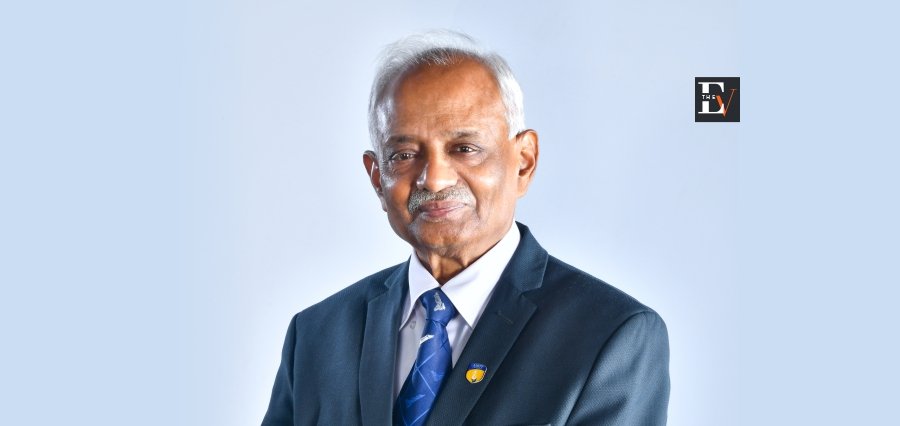
For nearly 40 years, Dr. W. Selvamurthy has been engaged in studying how human bodies survive on the brink of endurance in the high-altitude conditions of the Himalayas, the freezing climate of polar stations, and deep-sea diving. He superannuated from DRDO on 28 February 2013 as Distinguished Scientist and Chief Controller, Research & Development (Life Sciences & International Cooperation)
Currently as President of the Amity Science, Technology and Innovation Foundation, and Chancellor of Amity University Chhattisgarh, he is transferring this expertise to a completely new domain, which is creating an ecosystem in which universities produce inventions, in addition to students.
Explore the journey of a scientist who is transforming research and education into engines of innovation and national progress.
From Physiology to the Front Lines
Dr. Selvamurthy began his professional life far from military laboratories, training in Human Physiology at Christian Medical College, Vellore. That grounding carried him into a 40-year career at the Defense Research and Development Organization, where he rose to Director General. Nearly fourteen years ago, he moved to Amity University, describing the arc of his career as one continuous evolution. “My life journey has been exciting, satisfying, and pleasant, with tremendous learning and evolution, right from my education in physiology to forty years in DRDO as a scientist, rising to the level of Director General, and now almost fourteen years at Amity University,” he says, describing his mission as “transforming Amity into a cradle of innovation and a temple of learning.”
A Mission Carried Into Academia
That mission traces its roots to the extreme environments he once studied. At DRDO, Dr. Selvamurthy worked with soldiers stationed in high-altitude terrain, hot deserts, polar arctic environment, underwater installations and aerospace environments, as well as personnel confronting chemical, biological, radiological and nuclear threats. His team’s objective was clear: to develop life-support technologies that would protect soldiers’ health and keep their performance optimal under punishing conditions. He calls that period the foundation of all that followed, crediting it with shaping “whatever I am today.” When the opportunity arose to bring that experience into higher education, he seized it as a chance “to develop a model in India where universities become cradles of innovation.”
The DIPAS Years: Science at High Altitude
As Director of the Defense Institute of Physiology and Allied Sciences, and Defense Institute of Psychological Research, simultaneously, Dr. Selvamurthy led research reaching into the lives of soldiers, examining personnel selection, nutrition, clothing, protective equipment, and ergonomic design and military motivation. His work addressed punishing physiological challenges in combat zones, including pulmonary edema, cold injuries, sleep disturbances, and loss of appetite at high altitude. He describes the culture at DIPAS as built around three pillars, research that was need-based, user-driven, and futuristic. “In DRDO, we worked in mission mode, incorporating a professional culture focused on tangible and intangible outcomes, return on investments, and timely achievement of research objectives and deliverables,” he explains. That discipline did not stay behind; he carried it into Amity’s academic environment.
Building an Innovation Ecosystem at Amity
Much of that transition was made possible, Dr. Selvamurthy says, by finding a kindred vision in Amity’s Founder President, Dr. Ashok K. Chauhan, who shared his conviction that research and innovation belong at the center of a university’s identity. That ideology gave rise to mission-mode programs at Amity, including the Amity Space Mission, the Amity Defense Technology Mission, and the Amity Quantum Mission, alongside initiatives in artificial intelligence, cybersecurity, food security, and biomedical technology development. Amity’s curriculum and pedagogy have been reoriented around research and innovation, and the university has nurtured startups among faculty and students.
The Philosophy of Benevolent Leadership
Ask Dr. Selvamurthy to define his approach to leadership, and he reaches for a phrase: benevolent leadership, blending the task and relationship dimensions of leading a team, built on decades of listening and learning from every experience, success, failure, criticism, and challenge alike. “I have always tried to demonstrate love, compassion, and empathy towards members of my team and their families,” he says. That style has earned him something more durable than authority: goodwill and willing cooperation. “Genuine appreciation, compassion and trust enable a leader to achieve much more through the willing cooperation and commitment of the entire team,” he notes.
Scaling a Culture of Research
Scaling that culture across a sprawling university system has not come without resistance. Dr. Selvamurthy points to a persistent challenge: spreading research capability across the many campuses that make up the Amity Universities, where some faculty pursue frontier science readily, while others need encouragement to move beyond teaching alone. What helped him overcome it was institutional vision combined with strategic partnership — the philosophy set by Dr. Ashok K. Chauhan, the leadership of Chancellors Dr. Atul Chauhan and Dr. Aseem Chauhan, and collaborations with government bodies including DRDO, the Department of Space, the Department of Atomic Energy, CSIR, ICMR and ICAR. The results speak in scale: Amity Universities have undertaken more than 500 funded projects, filed more than 2,960 patents and facilitated 35 technology transfers. Through it all, Dr. Selvamurthy credits a deeper source of strength. “I have always been guided by the supreme force, God Almighty, who has stood with me during difficult times and given me the courage and conviction to move forward,” he says.
Technology in Service of Academic Rigor
Keeping an institution relevant amid technological change is a challenge Dr. Selvamurthy meets head-on. Amity has folded artificial intelligence, machine learning, virtual reality, data analytics, and generative tools such as ChatGPT into its research and classrooms, alongside computer vision, neural networks, and large language models. Even so, he draws a clear line between adoption and substitution. “Technology has to complement academic rigor rather than replace it,” he insists, framing Amity’s approach as one where emerging tools support quality teaching and experiential learning rather than replace it.
A Career Marked by Recognition
Across a career marked by many honors, one recognition stands apart: the Lifetime Achievement Award in Clinical and Preventive Cardiology, presented in 2006 by former President of India Dr. A.P.J. Abdul Kalam. His other accolades include the Academician Mirsaid Mirrakhimov Award from the Kyrgyz Republic for high-altitude medicine (2012), DRDO’s Technology Leadership Award (2010), CSIR’s National Award for S&T Innovations, and the ICMR Shakuntala Amir Chand Award.
But cardiology work carries the deepest meaning, rooted in research demonstrating that regression of coronary artery blockage is achievable through a lifestyle intervention combining Raja Yoga meditation, a low-fat, high-fiber diet, and regular aerobic exercise. More than 524 patients took part, and the findings shaped the Healthy Heart Program at Global Hospital, Mount Abu, run with the Brahma Kumaris. “For a scientist, there can be no greater satisfaction than seeing research move beyond laboratories and publications and contribute directly to improving human health and well-being,” he says.
Preparing for Tomorrow’s Global Leaders
Dr. Selvamurthy frames mentorship in national terms, invoking Prime Minister Narendra Modi’s vision of Viksit Bharat, which aims to transform India into a developed nation by 2047, the centenary of independence. He points to India’s demographic advantage as one of the world’s youngest nations, describing it as a rare opportunity that will not remain open indefinitely.
Beyond technical skill, he wants students to be equipped with knowledge, soft skills, values, and resilience. “Education should not merely prepare a young person for employment; it should prepare the individual for life, leadership, and responsible citizenship,” he says, invoking the Indian philosophy of Vasudhaiva Kutumbakam, the world as one family.
Institutions as Engines of National Development
Dr. Selvamurthy argues for a shift away from classroom-bound learning. With information now freely available through the internet and AI-enabled search, he believes universities must expose students to industry needs, societal realities, and global experience, cultivating creativity, critical thinking, and problem-solving ability. He points to Amity’s global alumni community as evidence, describing graduates who have succeeded not only in their careers and leadership roles but also in their lives.
He advocates brainstorming sessions, internships, apprenticeships, and field studies connecting students with rural, urban, and varied socioeconomic environments. His vision for universities is unambiguous: they must become engines of national transformation, rather than mere degree-granting institutions, generating knowledge, technologies, and enterprises that strengthen Atmanirbhar Bharat and Viksit Bharat.
Advice for Aspiring Education Leaders
For education leaders hoping to leave a lasting mark, Dr. Selvamurthy’s advice centers on wholeness, developing the analytical and creative faculties of the mind in balance with love, compassion, and empathy, and weaving creativity, innovation, and problem-solving into education systems. Above all, institutions must help every student discover their inherent potential. “Every learner is different, and the responsibility of an educational institution is to recognize, nurture, and develop that potential,” he says, adding what he considers the ultimate measure of success: “Every student should be groomed as a success story.”
A Vision for the Future
Looking to the future, Dr. Selvamurthy envisions education, research, and innovation operating as a single continuous chain. “Education should create knowledge; knowledge should lead to research; research should lead to innovation; and innovation should ultimately improve the quality of human life,” he says. He draws optimism from India’s civilizational depth its traditions of the Vedas, Upanishads, Bhagavad Gita, yoga, and Ayurveda, and believes the country can re-emerge as a Vishwa Guru by fusing that wisdom with modern science and entrepreneurship.
As for his legacy, he is precise: an ecosystem in which education produces compassionate human beings, research generates knowledge of consequence, and innovation becomes an instrument for societal and national development. It is, in many ways, the same mission that has guided him since his earliest days studying soldiers in the world’s harshest environments. His story is a reminder that scientific careers need not follow a narrow track that the discipline which protects a soldier on a frozen mountaintop can, decades later, shape the minds of young Indians building the nation’s future.