Prime Highlights :
- USask signed a new agreement with the IAEA to expand nuclear research, education and professional training.
- The partnership will strengthen Canada’s nuclear research capabilities and connect local experts with global scientific networks.
Key Facts :
- The University of Saskatchewan is a leading Canadian research university with expertise in nuclear science, medicine and energy.
- The International Atomic Energy Agency is a United Nations organisation that promotes the safe, secure and peaceful use of nuclear technology.
Background :
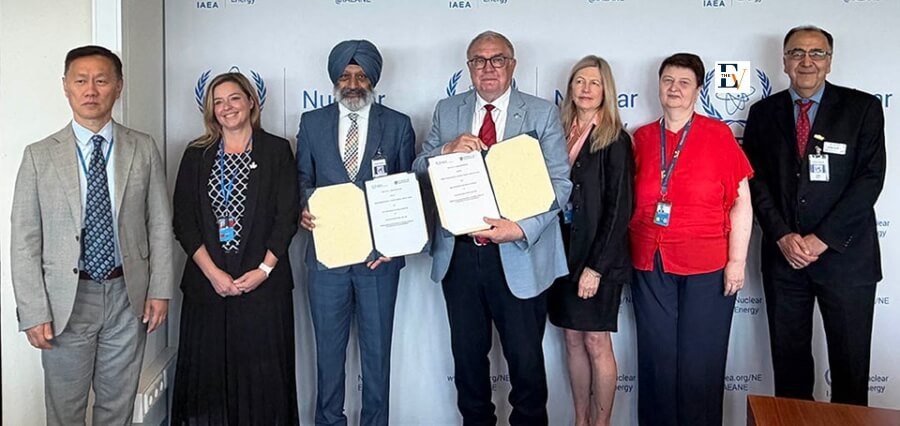
The University of Saskatchewan (USask) and the International Atomic Energy Agency (IAEA) have signed an agreement to enhance their nuclear research, education and professional training programs. It seeks to create a relationship between the two institutions through which they can develop professionals and advanced technologies in the field of nuclear science.
It will provide USask with the opportunity to train professionals in Canada while at the same time conducting research in nuclear science. It also strengthens the university’s role as a centre for nuclear education and innovation.
USask has built strong expertise in nuclear research through work in nuclear medicine, nuclear energy, nuclear fuels, nuclear waste management and public policy. The university is also home to major research facilities, including the Saskatchewan Cyclotron Facility and the Canadian Light Source, Canada’s only synchrotron. These facilities support research in healthcare, energy and other scientific fields.
The partnership builds on earlier collaboration between the two organisations. In collaboration with the IAEA, USask held the Canadian National Nuclear Energy Management School in 2025 to offer mid-level professionals specialized training. Earlier this year, it also organised Canada’s first Executive Nuclear Energy Management School for senior leaders from industry, government and academia.
USask Vice-President Research Baljit Singh said the agreement would strengthen the university’s research and education programmes while connecting Canadian talent with international experts. Associate Dean Jafar Soltan said the partnership would help establish USask as a national centre for nuclear training and innovation. IAEA Deputy Director General Mikhail Chudakov said the university has made important contributions to nuclear science for many years and that closer collaboration would support the growing global demand for safe and peaceful nuclear technologies.