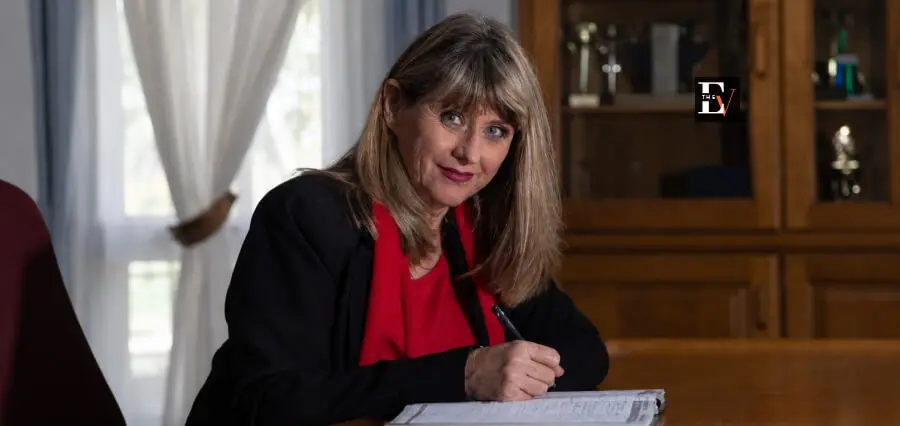
Sometimes a career starts with an informed choice. Sometimes, it all begins with an unassuming afternoon that leaves a lasting impression on you. The former is true for Marthie Combrinck, whose career started when she decided that she will not let go of the afternoon that left an indelible mark on her in that pediatric occupational therapy room. This particular afternoon took place when she was in Grade 10 and her nephew who had severe epilepsy and developmental delays to an appointment that marked the beginning of a new path for her life.
The therapist focused on the inherent strengths of the little boy rather than the clinical file, and the boy became someone beyond his diagnosis for that one afternoon in the pediatric therapy room. That day, Marthie Combrinck made a lifelong commitment that she will never give up on. “Belonging is not a privilege to be earned, but a fundamental human right,” she says. The sentence seems almost like a mission statement for everything she created since that afternoon. She vowed to herself to dedicate her career to bridging the gap between therapy and education.
A National Stage for a Rural School
Combrinck’s career has collected its share of accolades, but one milestone stands apart. In 2025, the Department of Basic Education named her the National Winner for Excellence in Special Needs Leadership at the National Teacher Awards. Recognition that, for Marthie, was never really about her.
Professionally, the award validated an integrative philosophy she has championed for decades: that specialized pedagogy and multidisciplinary therapy cannot exist in silos. “Special needs support cannot operate in isolation; it requires the harmonious blend of clinical care and classroom practice,” she explains, describing an approach she has spent her career refusing to compromise on, even when institutional pressures pushed toward simpler, siloed models.
What it accomplished institutionally was far more significant still. It put a national spotlight on a school in one of KwaZulu-Natal’s most underprivileged and rural pockets – a place where children face the challenges of physical and mental impairment together with socio-economic disadvantage. Up there on that platform, Marthie realized she was not really accepting an award for herself. Rather, she was representing all those educators, multidisciplinary teams, and learners who show that exceptional special needs education is possible anywhere.
Leading with Intentional Kindness
Ask Combrinck to describe her leadership style, and she will resist the word “soft.” In high-stakes institutional management, she notes, kindness is too often mistaken for weakness. She sees it instead as a rigorous, high-impact methodology -one rooted in the simple, universal human need to be recognized.
“When leadership creates an environment where individuals are genuinely recognized, mutual respect replaces institutional inertia and compliance becomes genuine commitment,” she says. It is a philosophy she has had to apply across an unusually complex web of stakeholders- teachers, therapists, medical personnel, and support staff all of whom she must orchestrate around a single unifying purpose: the progress of the child. Leading with empathy, she has found, does more than build morale. It builds the kind of deep institutional trust and fierce loyalty that inspires staff to innovate rather than simply comply.
The Barrier Beyond the Classroom
Not every challenge Combrinck has faced has a pedagogical solution. In many rural South African communities, she explains, physical and cognitive disabilities remain shrouded in cultural stigma, fear, and generations-old superstition. Mothers of children born with developmental delays are frequently ostracized, carrying an unjust burden of blame for something entirely outside their control.
This reality reshaped how Marthie approaches her work altogether. The primary obstacle, she came to realize, is rarely pedagogical, but rather social isolation. Long before formal teaching can begin, her team must first dismantle layers of shame, helping entire communities understand disability not as a curse but as a natural variant of human experience. That realization pushed her away from a purely clinical lens, diagnostic criteria, and adapted lesson plans toward something broader: an ecological approach that treats a child’s neurodiversity as inseparable from their cultural narrative, family dynamic, and socioeconomic reality. True inclusion, in her view, means educating the whole community, not just the child in front of her.
Staying Sharp in a Fast-Moving Field
Running a busy rural school leaves little room for idle study, yet Combrinck treats professional development as non-negotiable. Every single day, she carves out fifteen to thirty minutes strictly for reading academic journals and tracking global best practices in leadership and learner support- a discipline she has maintained for years, regardless of how demanding the calendar becomes.
Increasingly, she has turned to modern artificial intelligence tools to make that habit sustainable, using them to synthesize dense neuroscientific studies and clinical research into strategies she can realistically apply within her rural context. For her, staying curious is not optional. It is, in her words, a professional obligation one that keeps her school’s practices innovative and evidence-based, even when resources are thin.
The Victories That Actually Matter
Combrinck holds a Paul Harris Fellowship and graduated top of her class with a Postgraduate Diploma in Educational Leadership and Management earned, notably, at age 50. She speaks of both with genuine humility but is quick to redirect the conversation toward what she considers the real measures of success: the quiet, daily breakthroughs inside her school’s hallways.
Nothing, she says, compares to watching a child with cerebral palsy summon every ounce of motor control to return a high-five, or hearing a nonverbal ten-year-old speak their very first words. These micro-victories are, to her, tangible proof of something larger. “No child is unreachable,” she insists: a conviction that has carried her school’s staff through systemic shortages and administrative hurdles that might otherwise grind momentum to a halt.
What Women Leaders Need to Carry
When asked what qualities matter most for women aspiring to lead in education, Combrinck answers without hesitation: Grit first. An unshakeable “spine of steel,” and having the professional resolve to advocate fiercely for one’s institution, staff, and learners within bureaucratic, under resourced systems, always keeping the child’s holistic well-being as the ultimate reference point for every decision. Communication comes next. The ability to speak with equal empathy and clarity whether negotiating with government officials, pitching philanthropic partners, or comforting an anxious parent: A skill she believes women are innately well-equipped to master. She also points to the need for operational consistency, translating research into practical daily strategy rather than letting vision outpace execution, and finally, a sharp strategic sagacity: the ability to spot opportunity in funding, in partnerships, in overlooked staff potential where others see only obstacles.
Partnership as a Sacred Focus
Combrinck is emphatic that no educator, therapist, or institution can succeed in isolation. A child’s developmental trajectory depends entirely on the strength and consistency of the network surrounding them. Building that network, she says, starts with one unifying principle: the child’s holistic development and future independence must be everyone’s shared, sacred focus. When every stakeholder aligns around that priority, professional egos and disciplinary silos tend to dissolve on their own.
In practice, her school leans on accessible digital channels to share real-time updates and home reinforcement strategies with families, alongside structured, face-to-face support circles where parents sit as equal partners beside therapists and educators – their insights into home behavior treated with the same weight as clinical assessment.
Advice for the Next Generation
For young professionals hoping to build a lasting career in this _ield, Combrinck’s advice is refreshingly unglamorous: get your hands dirty before expecting position or prestige. Volunteer at local special schools, rehabilitation centers, and community crèches. Ground theory in direct, real-world contact with neurodiverse children, because true pedagogical wisdom, she insists, is forged on the frontlines of human service and not in a classroom. Approach every day with curiosity and an eagerness to serve, she urges, and professional doors will open naturally. Above all, build internal resilience against systemic inefficiencies and funding shortfalls, because this calling demands an unconditional love for diverse learners. “Step forward boldly, it offers one of the most deeply fulfilling journeys life can provide,” she says, and the line lands less like advice than like testimony.
What Comes Next
Combrinck isn’t slowing down yet. In the early days of her career, she developed, together with colleagues, an assessment and education tool based on outcome measures for learners with intellectual disabilities. The tool was used in about 70 specialized schools in South Africa at the time, which proves, she claims, that early guidance can help unravel the mystery of the disabilities before children enter regular schooling. Currently, she works as a Principal and Occupational Therapist at Thuthukani Special School.
Marthie’s future plans have two directions. The first one is to enable rural communities to get involved in early intervention using an offline mobile application that would allow conducting screening and supporting children at home within the windows of neuro-developmental opportunity. She aims to develop the application together with tech developers and philanthropic funders. The second direction is to turn Thuthukani Special School into a practitioner training center where future educators and therapists get clinical and teaching experience. These plans represent exactly what she wanted to do when she was a teenager sitting in that therapy room: to build bridges and nurture the spark inside.