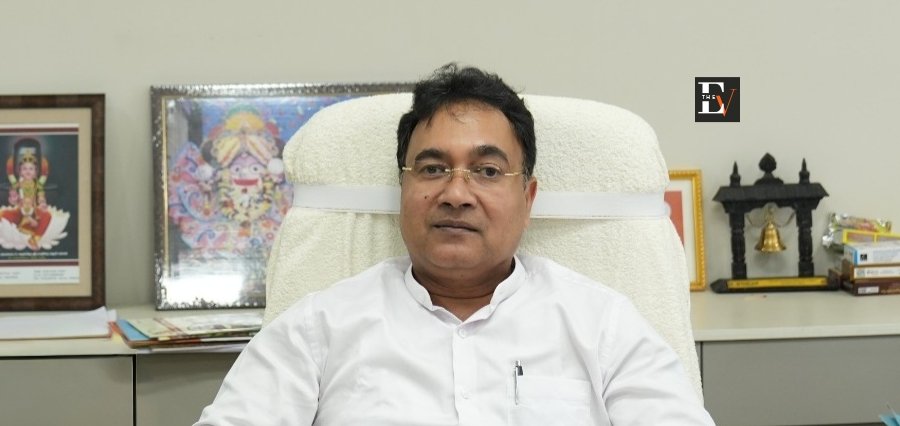
Universities that genuinely shape the future are led by people who never stopped being students themselves. The best academic leaders bring curiosity, intellectual honesty and a real investment in the people around them to everything they do. Prof. Dr. Parma Nand, Vice Chancellor of Sharda University Agra, leads from exactly that place. His career spans research, teaching, accreditation work and institutional development. Through all of it, one belief has remained constant: education reaches its full potential only when it creates knowledge, builds character, and genuinely prepares students to contribute to a world.
Inspired by Learning, Committed to Teaching
For Prof. Dr. Parma, education has always been driven by curiosity rather than the pursuit of degrees. During his B.Tech at IIT Delhi, he discovered that computer science was a field where learning never stops. As he progressed through his M.Tech, he became increasingly interested in solving complex problems and understanding the theory behind emerging technologies. This naturally motivated him to pursue a Ph.D. at IIT Roorkee, where he had the opportunity to contribute to research and develop a deeper perspective on innovation.
The turning point in his journey came when he began interacting with students. He realized that the greatest satisfaction did not come from solving a problem himself, but from helping others learn how to solve it. Watching students grow into confident engineers and researchers gave him a sense of purpose that went beyond personal achievements. Over the years, teaching, research, and academic leadership have become inseparable parts of his career.
Whether mentoring students, leading funded research projects, organizing international IEEE conferences, or building industry collaborations, his goal has always been to create opportunities for learning, innovation, and societal impact. He strongly believes that “Education is not just about earning qualifications. It is about creating knowledge, inspiring young minds, and empowering the next generation to solve real-world challenges.” That belief continues to motivate him every day.
Leading with Vision and Continuous Improvement
Leading institutions through NAAC and NBA accreditation, serving as a NAAC Assessor, NBA Evaluator, and NABET Assessor, and collaborating with industry and professional bodies have profoundly shaped Prof. Dr. Parma’s leadership philosophy. He believes leadership is about empowering people, fostering collaboration, and driving continuous improvement. According to him, a successful leader creates an environment where innovation, accountability, and excellence flourish while ensuring that every stakeholder contributes meaningfully to the institution’s vision.
He defines visionary leadership as going beyond administering an institution. It is about anticipating future educational and societal needs while preparing learners for careers and professions that are constantly evolving. He believes visionary leadership requires integrating technology with human values, promoting multidisciplinary learning, strengthening research and innovation, and fostering global competencies.
Rather than simply responding to change, visionary leaders proactively shape institutional strategies that enhance academic excellence, employability, entrepreneurship, and societal impact.
Preparing Learners for the Future
Prof. Dr. Parma’s approach to education is aligned with the vision of NEP 2020, Industry 4.0/5.0, and Education 5.0. He emphasizes experiential learning, interdisciplinary education, research, innovation, entrepreneurship, and industry engagement. By integrating emerging technologies such as Artificial Intelligence, Data Analytics, and Cyber Security into the curriculum while promoting critical thinking, problem-solving, and ethical leadership, he is preparing graduates who are globally competent, professionally skilled, and socially responsible.
Technology, he believes, has become central to educational transformation. The institution leverages AI-enabled learning platforms, smart classrooms, virtual laboratories, digital assessment tools, and industry-integrated curricula to create engaging learning experiences. Beyond digital adoption, his emphasis is on cultivating an innovation ecosystem where students actively participate in research, patent development, product innovation, and startup initiatives. He believes this approach bridges the gap between academic learning and industry expectations.
Leading Inclusive Education with Excellence, Research, and Collaboration
For Prof. Dr. Parma, quality education must be accessible and inclusive. He promotes learner-centric policies, flexible academic pathways, digital resources, mentoring, financial support, and continuous quality assurance mechanisms to ensure equitable learning opportunities. He emphasizes faculty development, outcome-based education, curriculum modernization, and regular academic audits to help maintain global standards while creating an inclusive environment that supports students from diverse backgrounds.
One of the most significant milestones in his career has been successfully leading institutions through NAAC and NBA accreditation while strengthening their research, innovation, and governance frameworks. His research contributions include more than 155 publications, six books, more than 125 published patents, and 48 granted patents. Equally rewarding has been mentoring researchers, securing funded projects, fostering industry collaborations, and contributing to national quality assurance initiatives that enhance institutional excellence.
Meaningful engagement, he believes, begins with shared purpose and participative governance. He encourages open communication, faculty empowerment, student participation, and strong industry partnerships. By recognizing excellence, promoting interdisciplinary research, supporting innovation, and strengthening collaborations with alumni, policymakers, and industry leaders, he has helped create a culture where every stakeholder actively contributes to institutional growth and academic excellence.
Addressing the Challenges in Higher Education
According to Prof. Dr. Parma, higher education faces challenges such as rapid technological disruption, employability gaps, digital transformation, and the need for continuous curriculum renewal. Addressing these challenges requires stronger industry-academia collaboration, faculty upskilling, research-driven innovation, and greater emphasis on interdisciplinary education.
He believes institutions must remain agile and future-focused while nurturing critical thinking, adaptability, and lifelong learning among students.
Envisioning the Future of Higher Education
Looking ahead, Prof. Dr. Parma envisions universities evolving into globally connected centers of innovation where education, research, entrepreneurship, and societal development converge. He believes the future of education lies in multidisciplinary learning, technology integration, sustainability, and global collaboration while preserving ethics and human values.
His advice to emerging leaders is to remain lifelong learners, embrace innovation with integrity, empower others through collaboration, and always keep students at the center of every decision. For him, great leadership is measured not only by institutional achievements but also by the positive and lasting impact created on individuals and society.